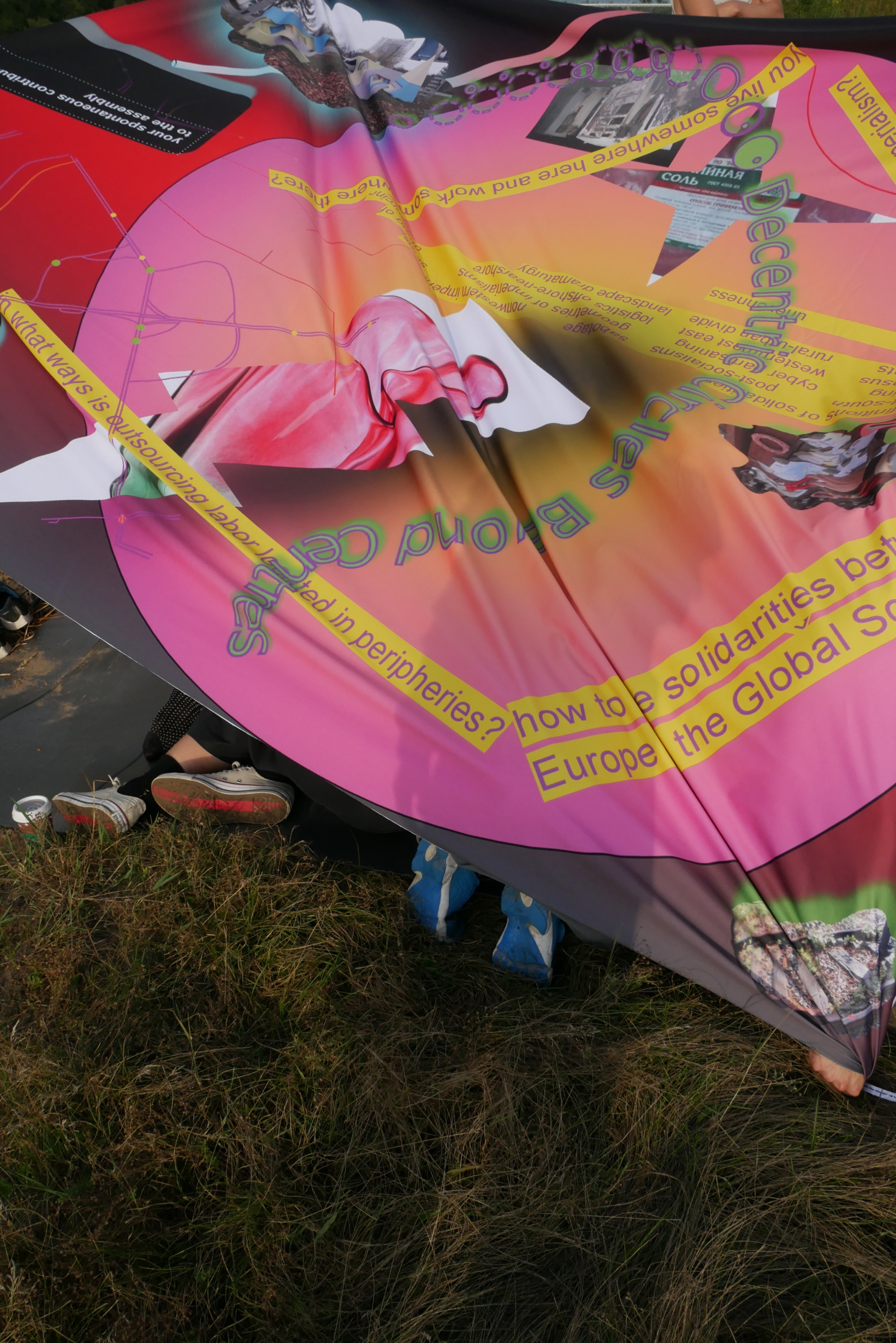
'Decentric Сircles Assembly' event series organized by Work Hard! Play Hard! working group, Warsaw 2024. Image by Work Hard! Play Hard! working group
ASSEMBLY, TOWARDS AN INFRASTRUCTURAL COMMONS
Specialisation module C21: Art and the Social
155.766: Art and the Social
155.767 Conceptual and Contextual Art
155.768 Forms of Activation
Convened by Rose-Anne Gush and Olia Sosnovskaya
Why assemble now? In today’s climate dominated by polycrisis - climate crisis, economic crisis, war - forms of public assembly can be understood as modes of cultural resistance. This semester, the course Art and the Social takes the assembly – a political form of gathering together, (un)learning, protesting, or for processes of deliberative democratic decision-making – as a frame to explore art’s relationship to society. Focusing on assemblies ‘from below’, we will begin by asking: what underpins an assembly? What infrastructures enable speaking, gathering, surfacing materials, showing histories, and amplifying marginalised voices? In short: what kinds of infrastructures make assemblies possible, and what social effects do these infrastructures produce? A core element of the course is a three-day field-work assembly at Museum Persmanhof, located at the Austrian-Slovenian border. Once a home to families who hosted partisans who resisted Nazis during WWII, the site later became a Nazi crime scene at the end of the war. Today, this unique museum functions as form of social infrastructure, a place of both remembrance and anti-fascist learning. During this intensive research assembly, students will engage directly with the site, its location in the mountains, and its histories, thereby developing field-work methodologies including oral history, sound recording, sketching, site writing, to engage with and uncover hidden, or overlooked narratives within the landscape.
Theoretical foundations for the course will include feminist, ecological and decolonial perspectives, as well as Lauren Berlant’s ‘infrastructural commons’, Marina Vishmidt’s ‘infrastructural critique’, Henri Lefebvre’s ‘production of space’, Kristin Ross’ idea of political memory and the ‘commune form’, and Andreas Malm’s notion of ‘partisan nature’. Through these frameworks, we will move beyond viewing art as a static object, instead approaching artistic practice as a living social process – one centered on the assembly and the infrastructures that activate it. This is a collaborative course built on research, critical discussion, and the development of individual artistic practices within a larger group project. It will culminate in a student-developed assembly, for which students will determine what is needed – conceptually, socially, and materially – to bring it into being. Materials for the physical site of the assembly may include wood, metal, textiles, cardboard, lights, projection, film, photography, sound, drawings, readymade or found objects. These elements should be brought together to form a spatial, performative, and discursive structure – one designed for collective engagement with the findings of the fieldwork – the histories, documents, stories, and lived experiences produced during the Peršmanhof Assembly.