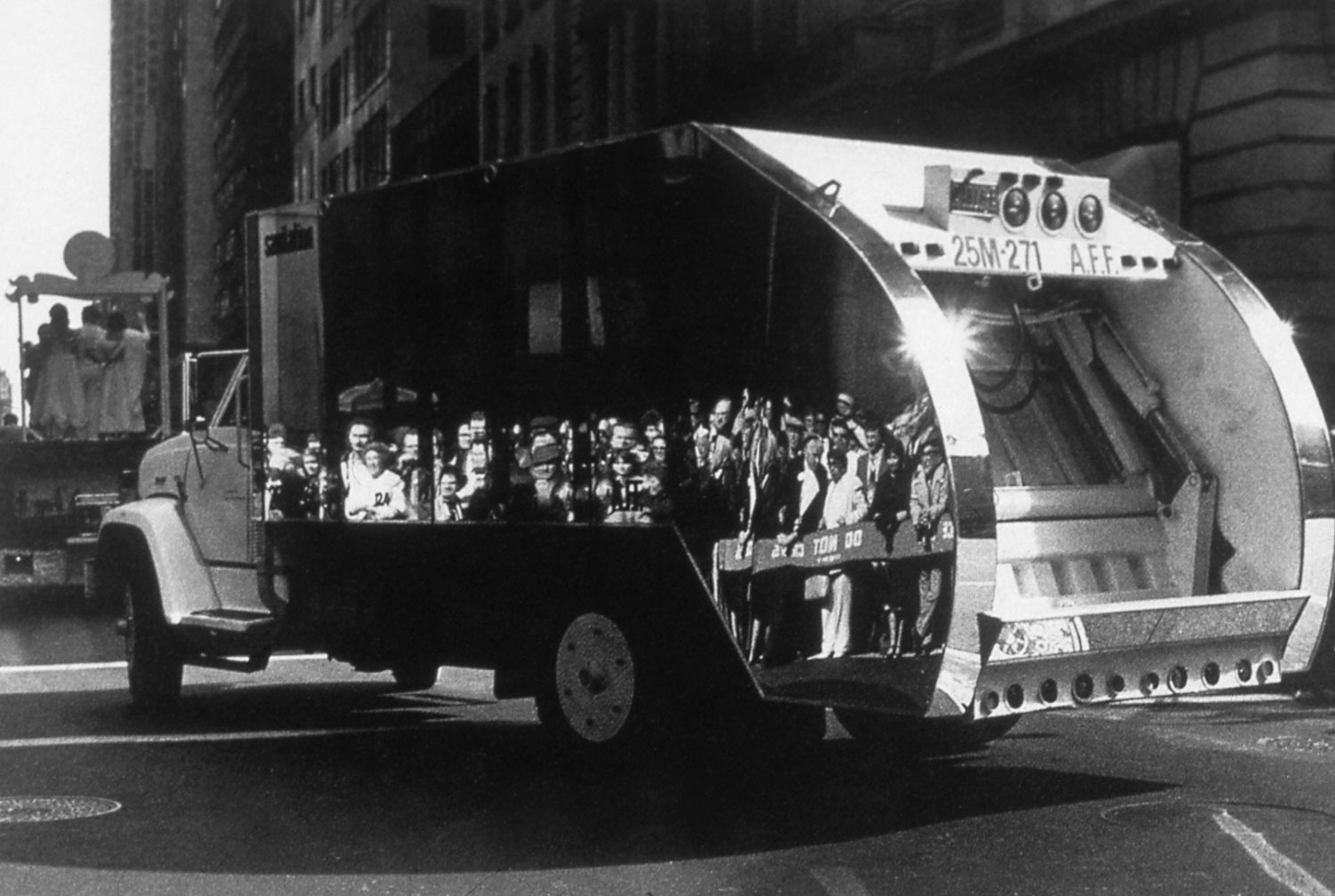
Mierle Laderman Ukeles, The Social Mirror, 1983
Mirror covered New York City Department of Sanitation truck, Courtesy of Ronald Feldman Fine Arts, New York
Conditions of Possibility. Strategies for Infrastructural Critique
155.518: Artistic Practice 1
Convened by Ahmad Darkhabani, Rose-Anne Gush, Budour Khalil & Frank Wasser
What does infrastructure make possible? What does it conceal? Power grids, server farms, highways, tunnels, dams, and mines are the visible face of infrastructure, but the concept also reaches into smaller feminist ecologies and practices of care, into the movement of ideas, and into language itself. This semester, Artistic Practice 1 explores the infrastructural systems that subtend, or form the conditions of possibility for contemporary life, to consider the transversality of their uses and operations. Students will choose particular sites, develop forms of research and critical questioning of those sites, to develop artistic propositions in relation to them.
Students will gain knowledge in conceptual art and institutional critique, referring to Lucy Lippard’s ‘Escape Attempts’ (1973) and Marina Vishmidt’s ‘Infrastructural Critique’ (2025), and a genealogy of artistic practices that interrogate the structures shaping cultural production. Through lectures, readings, discussions, and case studies from Hans Haacke to Andrea Fraser and Cameron Rowland, the course will explore how critical artistic strategies engage with histories or gender oppression and racial capitalism, to repurpose or modify violent and harmful infrastructures that reproduce our world, inside and outside the institution, reorienting their operations? Can art block or redirect the conditions of reproduction of contemporary life? How far can art reach “out” before it is recuperated by capitalist accumulation? What are the limits to transgressions by means of artistic form and critique?
Students will work in groups to develop artistic projects that engage a materialist critique of infrastructure across scale. By the end of the semester, students will have developed their own artistic strategies for investigating, and transforming the infrastructural systems within sites of their choice—that shape the world around them.