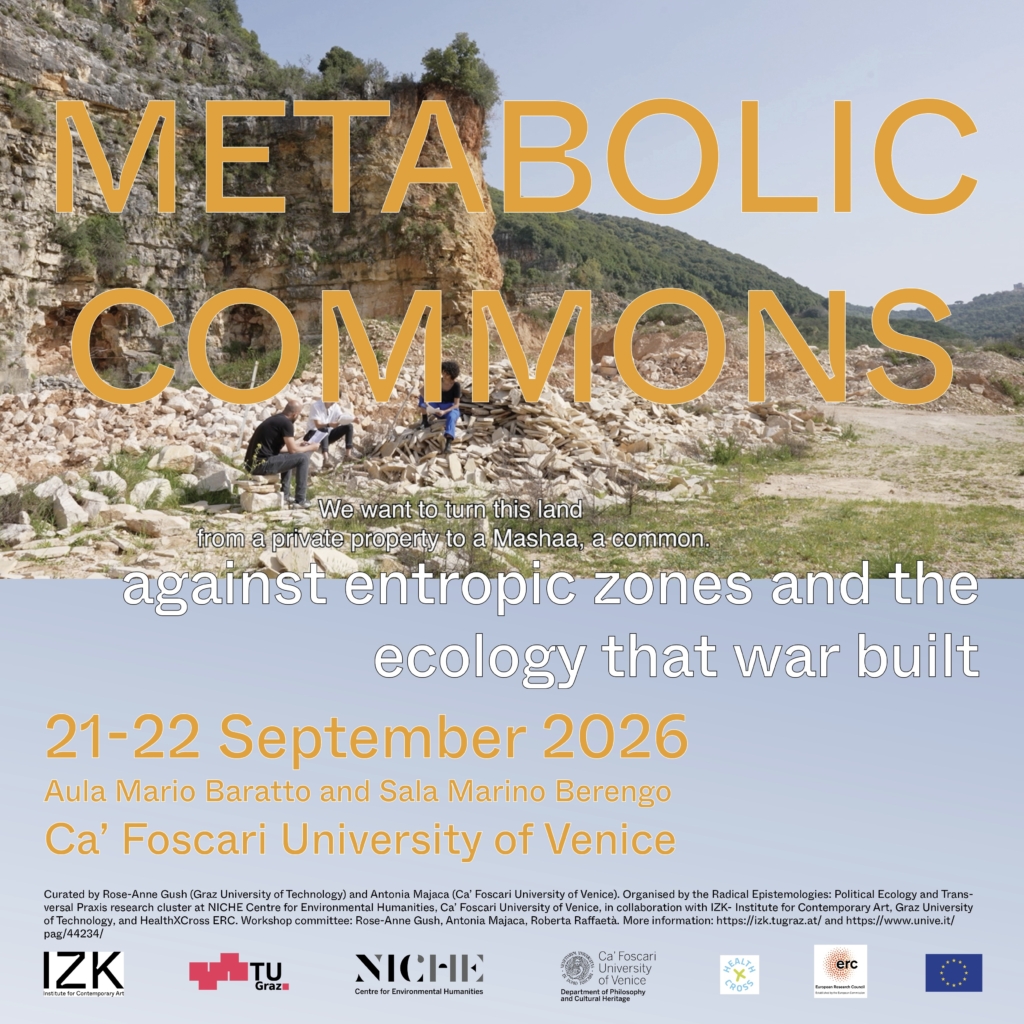
A Feminist Political Ecology Workshop
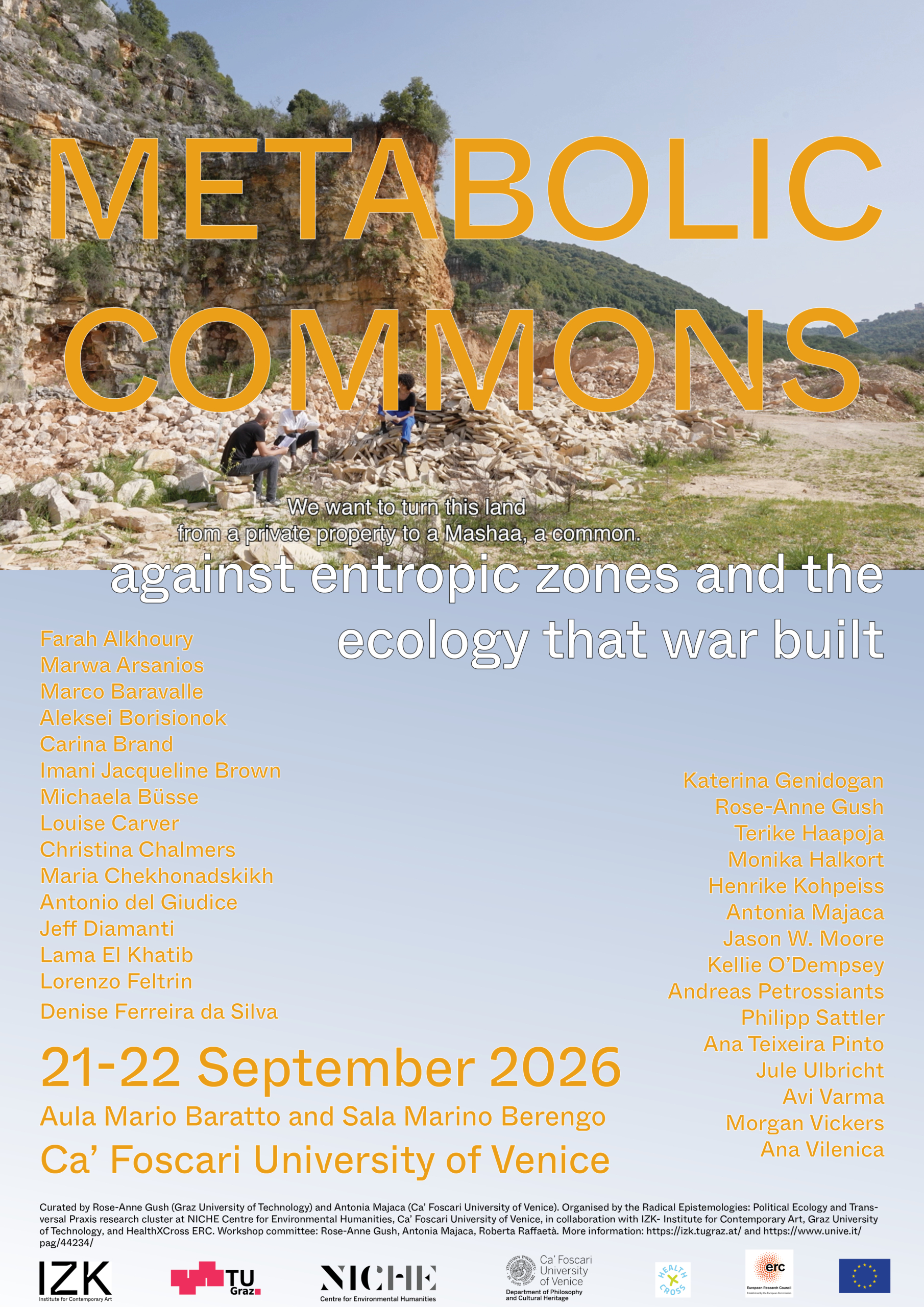
21–22 September 2026
Aula Mario Baratto and Sala Marino Berengo, Ca' Foscari University of Venice
IZK - Institute for Contemporary Art, TU Graz in collaboration with NICHE Centre for Environmental Humanities, Ca' Foscari University of Venice
The dominant frameworks informing contemporary environmental governance, climate policy, and energy transition emerged from Cold War military funding, colonial field sites, and postwar techno-scientific infrastructures. The energy-flow paradigm organizing contemporary systems ecology, climate modeling, and green transition planning descends from a lineage running from Wilhelm Ostwald’s energetics through Alfred Lotka’s physical biology to Howard T. Odum’s maximum power principle, in which life was progressively reformulated as thermodynamic process, competition was encoded as ecological ground, and the question of political accountability was systematically excluded from the descriptive apparatus. When contemporary systems ecologists, biophysical economists, and green transition planners deploy this vocabulary, what political silences does that inheritance carry, and what becomes of questions about power, property, and reproductive labor when they enter a grammar built on energy flow?
In thermodynamics, entropy names irreversible dissipation: available energy converted to a form that cannot be reconverted. The entropic zone is its political-economic equivalent, a territory, community, or body whose available social-ecological energy has been irreversibly dissipated through extractive operations. Accumulated metabolic labor, ecological knowledge, commons resources, reproductive capacity are all converted into the conditions of accumulation elsewhere, made to appear as the natural background of that accumulation rather than its precondition. This workshop borrows the thermodynamic vocabulary deliberately and against the grain of its inheritance.
The energy transition reorganizes rather than resolves this structure, shifting the extractive frontier and subsidizing decarbonization through reproductive and subsistence labor that remains unaccounted for in both capitalist valorization and the energetic models informing transition planning. The planetary scale of contemporary mineral extraction connects spatially dispersed sites, from Lubumbashi to Wolfsberg and from southern Greenland to the Atacama, into a single infrastructure of accumulation, while the entropy it produces remains local, absorbed by the communities at the point of extraction.
The metabolic commons, the specific configurations of land, water, and collective practice through which communities reproduce the conditions of the living, are historically produced, always already gendered and racialized, and under threat from the same operations that constitute natural resources as independently extractable. The concept of metabolism, before its absorption into energetics, designated the continuous dynamic exchange between organisms and their environments: open, non-static processes whose quality depends entirely on the relations through which they are organized. The feminist materialist tradition has consistently demonstrated that the gendered division of labor constitutes the originary template of capitalist accumulation, and that destruction does not stop at the landscape. It registers in the microbiomes of the communities who absorb it, the microbial ecologies accumulated through generations of specific land-based diets and ecological relations, irreversibly depleted by the same industrial food systems, antibiotic regimes, and toxic exposures that abolitionist geography names as organized abandonment: the deliberate withdrawal of life-sustaining infrastructure from communities and territories rendered surplus to accumulation.
This workshop brings together ecological Marxism, feminist materialism, the history and philosophy of science, decolonial science studies, and political ecology to further a feminist political ecology of metabolic commons adequate to the present conjuncture.
Speakers include:
Farah Alkhoury, Marwa Arsanios, Marco Baravalle, Aleksei Borisionok, Carina Brand, Imani Jacqueline Brown, Michaela Büsse, Louise Carver, Christina Chalmers, Maria Chekhonadskikh, Antonio del Giudice, Jeff Diamanti, Lama El Khatib, Lorenzo Feltrin, Denise Ferreira da Silva, Katerina Genidogan, Rose-Anne Gush, Terike Haapoja, Monika Halkort, Henrike Kohpeiss, Antonia Majaca, Jason W. Moore, Kellie O'Dempsey, Andreas Petrossiants, Philipp Sattler, Ana Teixeira Pinto, Jule Ulbricht, Avi Varma, Morgan Vickers, Ana Vilenica
All welcome.
Full programme and more details to follow, watch this space.
Organized by the Radical Epistemologies: Political Ecology and Transversal Praxis research cluster at NICHE Centre for Environmental Humanities, Ca’ Foscari University of Venice, in collaboration with IZK—Institute for Contemporary Art, Graz University of Technology, and HealthXCross ERC at the Department of Philosophy and Cultural Heritage, Ca’ Foscari University of Venice.
Curated by Rose-Anne Gush (Graz University of Technology) and Antonia Majaca (Ca’ Foscari University of Venice).
For all inquiries, please write to antonia.friedman@unive.it and r.gush@tugraz.at.