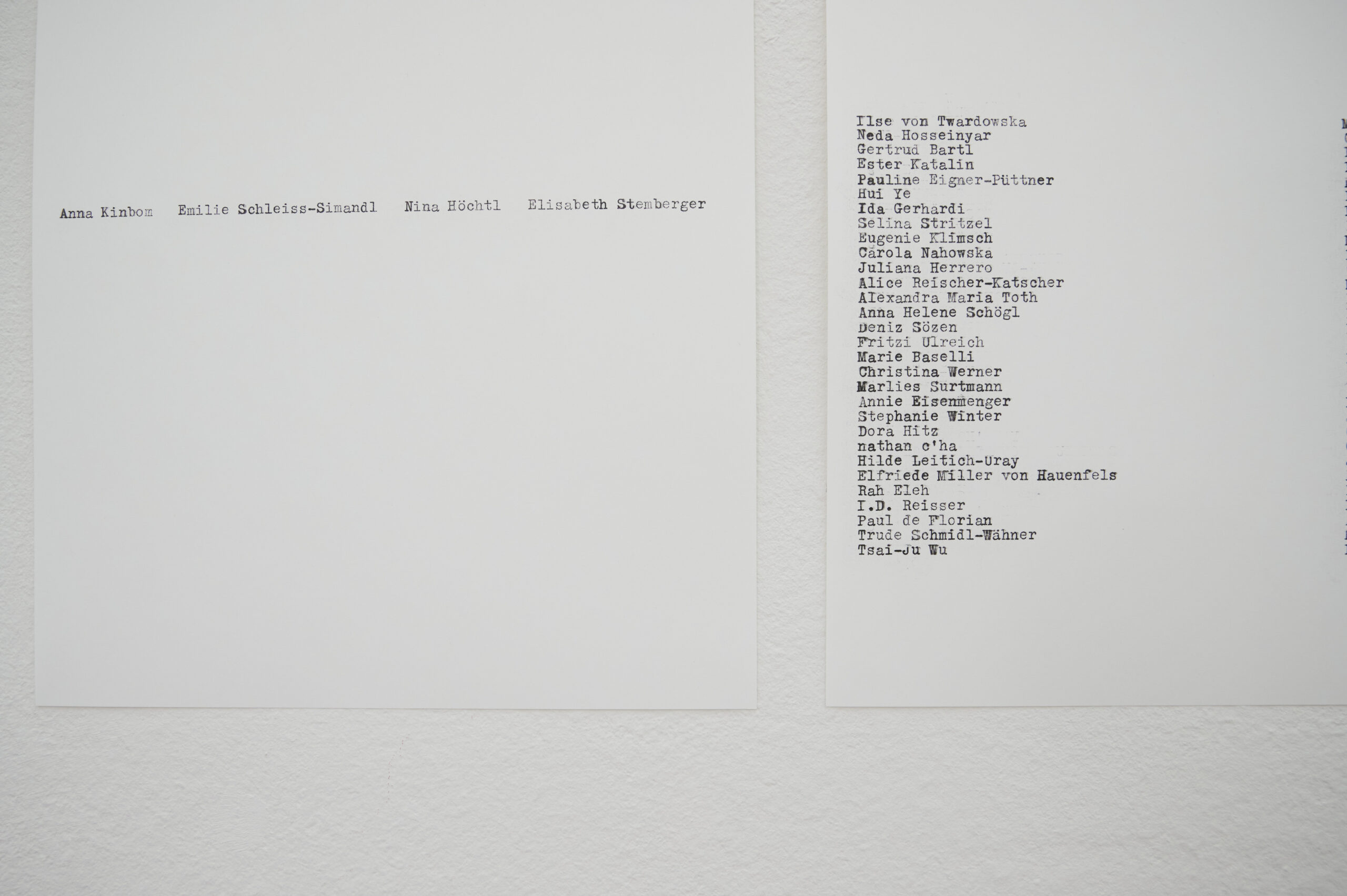
Ivana Lazić, The Register (The Third Woman),installation, approx. 30 A4 sheets, hand typed; sound installation, 10 min looped, 2023. From the group exhibition: Archival Sites of Speculation: Storying the Silence, at the Austrian Association of Women Artists (VBKÖ). Photo by © by Daniel Hill, 2024.
MODELS OF ORGANISING: THE ART ASSOCIATION
155.766: Transdisciplinary Art-Based Research
Convened by Ahmad Darkhabani
Performing a historical reading on the emergence of art associations in the German-speaking world is necessary to gain a deeper understanding of the social and political shifts that prompted individuals to form social circuits concerned with pressing issues at the time. The proliferation of these associations (Vereine) by the mid-nineteenth century in Germany can be understood as symptomatic of a new structure of social organisation shaped by the Industrial Revolution and evolving perceptions of art and its role within industrialised societies. (Thomas Nipperdey, 1996)
In this course, students will take the contemporary relevance of art associations as a point of departure to investigate how art functioned as a social bond among individuals seeking to resist discriminatory social and political regimes. A central case study will be the Austrian Association of Women Artists (VBKÖ), founded in Vienna in 1910 to support the work of women artists. Focusing on the moment when the association demonstrated compliance with state ideology during the economic crisis of the 1930s, students will examine the entanglement between models of social organisation and political influence.
The course will involve site visits to the (VBKÖ) in Vienna, where students will conduct research in the association’s archive. Approaching the archive as a space that holds the key to rethink the link between past and present, students will employ artistic tools and methodologies to propose ways of organising and historising that respond to present struggles. This approach will be enriched by input from various positions currently developing distinctive models of collaboration within the arts across Austria, the Netherlands, and Ireland.